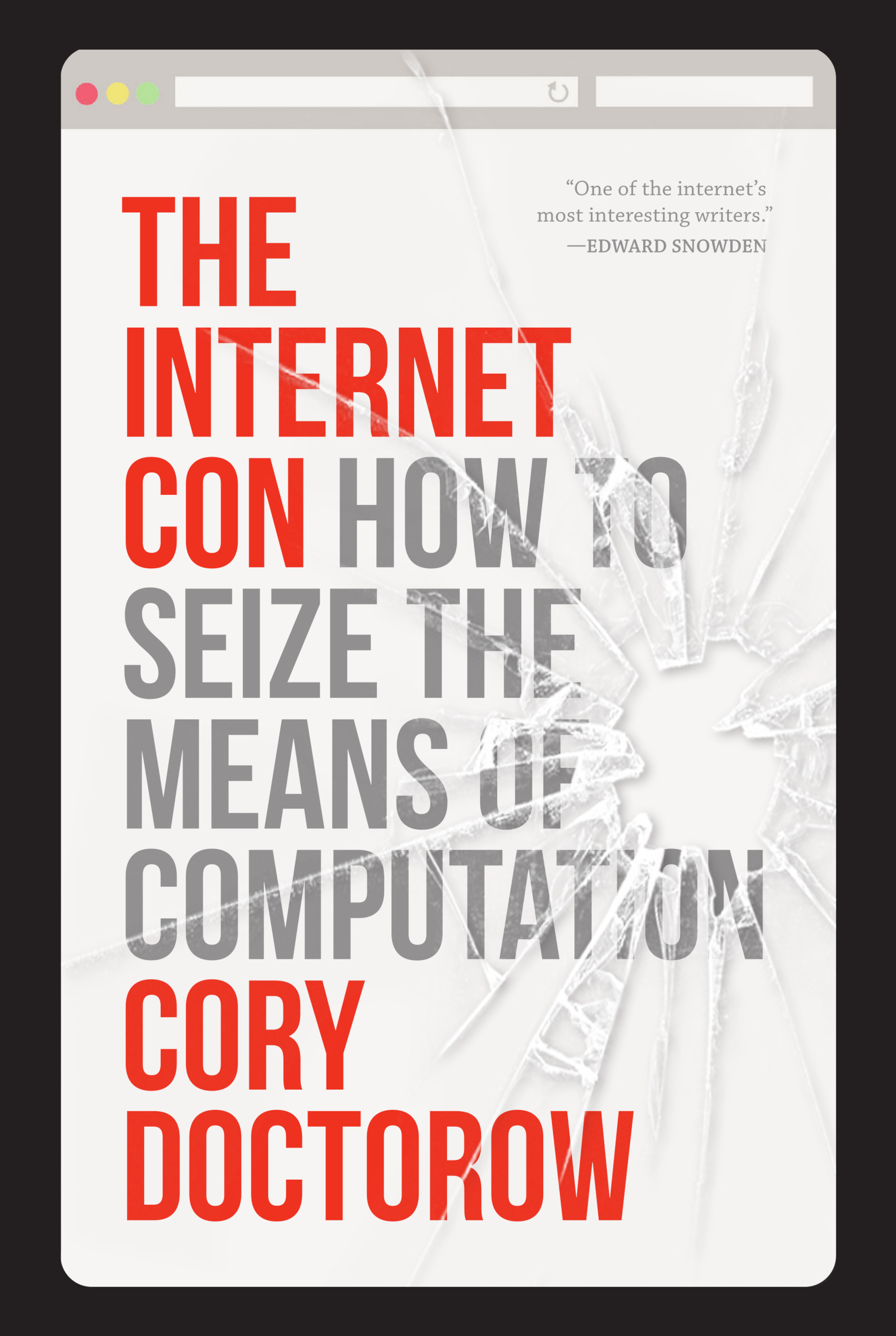

Nicolas Fressengeas a publié une critique de Le rapt d'Internet par Cory Doctorow (Duplicate)
Le code, la loi et le profit : analyse de l'aliénation numérique par Cory Doctorow
4 étoiles
Je ne peux pas vraiment dire que j'ai découvert Cory Doctorow à l'occasion de la lecture de ce livre. C'est parce que je le connaissais, et tentais de le suivre sur les réseaux sociaux et à travers son site Internet, que j'en ai fait l'acquisition. Mais la réalité est pourtant là : je l'ai découvert par ce livre. Le rabat de couverture indique que "Cory Doctorow est une des personnes les plus influentes de l'Internet. Auteur de science fiction, il est considéré comme une des plumes majeures de la seconde vague du cyberpunk". Non seulement, je n'arrive pas à le suivre, à travers quelque canal que ce soit, tellement il est prolixe, mais je découvre également qu'il écrit de la science fiction, qu'il me faudra explorer… Bien, concentrons nous sur cet ouvrage, qui a l'avantage d'avoir été traduit dans ma langue maternelle.
Le rapt d'Internet, ou …
Je ne peux pas vraiment dire que j'ai découvert Cory Doctorow à l'occasion de la lecture de ce livre. C'est parce que je le connaissais, et tentais de le suivre sur les réseaux sociaux et à travers son site Internet, que j'en ai fait l'acquisition. Mais la réalité est pourtant là : je l'ai découvert par ce livre. Le rabat de couverture indique que "Cory Doctorow est une des personnes les plus influentes de l'Internet. Auteur de science fiction, il est considéré comme une des plumes majeures de la seconde vague du cyberpunk". Non seulement, je n'arrive pas à le suivre, à travers quelque canal que ce soit, tellement il est prolixe, mais je découvre également qu'il écrit de la science fiction, qu'il me faudra explorer… Bien, concentrons nous sur cet ouvrage, qui a l'avantage d'avoir été traduit dans ma langue maternelle.
Le rapt d'Internet, ou The internet con en version originale — con signifie arnaque —, est sous-titrée Manuel de déconstruction des Big Tech, ou comment récupérer les moyens de production numérique. Écrivons le tout de suite : autant le titre reflète parfaitement le contenu de l'ouvrage, autant les sous-titres décevront le lecteur. Après une parfaite analyse sur laquelle je reviens plus bas, l'auteur livre en effet des clefs aussi intéressantes qu'importantes pour nous permettre de récupérer les moyens de production numérique. Malheureusement, comme l'on pouvait s'y attendre, toutes les actions suggérées ne peuvent être que des actions collectives coordonnées, ou des actions de niveau gouvernemental, étant pour la plupart d'entre elles d'ordre législatif.
Or, il est aujourd'hui relativement évident que l'action coordonnée ne pourra avoir lieu, tant le pouvoir d'influence de ceux qui détiennent désormais le pouvoir numérique est grand. Cette dernière assertion est mienne, mais la lecture de l'ouvrage ne permet pas de la démentir. L'autre voie, plus législative, gouvernemental, présente un avenir moins sombre : des avancées intéressantes en Europe ont eu lieu : le DSA et le DMA — Digital Service Act ou réglementation des plateformes numériques & Digital Market Act, son pendant pour les marchés numériques — sont proches des avancées législatives prônées par l'auteur. Citons également le récent EDIC — European Digital Infrastructure Consortium, un consortium européen pour une infrastructure numérique — dénommé Digital Commons — les communs numériques — dont les objectifs correspondent bien au sous titre de ce livre : la récupération des moyens — européens — de production numérique. Citons finalement le tout récent rapport de la commission d’enquête sur nos vulnérabilités et dépendances numériques, dont les éléments d'analyse et les conclusions sont également proches des propositions de Cory Doctorow. Espérons que les premiers, de belles infrastructures juridiques seront réellement appliquées malgré les intenses pressions géopolitiques pour que ce ne soit pas le cas. Leurs effets pourrait en effet être des plus importants : l'un d'entre eux pourrait notamment être que ce nouvel EDIC produise réellement ce pour quoi il a été conçu ; un autre pourrait être un appui européen à la mise en oeuvre des préconisations du rapport d'enquête parlementaire à portée nationale précité.
Mais revenons à cet ouvrage, dont le tropisme est plus américain qu'européen. Rappelons tout d'abord que Cory Doctorow est l'inventeur du terme anglophone enshitification dont la traduction française — belge — a été proposée par Lionel Dricot, alias Ploum, sous le terme merdification, bien plus pertinent qu'_emmerdification_comme suggéré par l'éditeur de cet ouvrage, qui est porteur de la connotation de l'ennui. Ce terme désigne en effet le processus que l'on pourrait appeler économique, par lequel une plateforme numérique attire ses utilisateurs par une illusion de gratuité, les enferme dans une dépendance, puis mets en place les conditions de rentabilité — forte — de ses services. C'est aussi le titre du dernier ouvrage de Cory Doctorow, non encore traduit en français — dont on espère qu'il le sera et que son titre sera merdification.
Deux parties, donc, dans ce livre ; deux parties fort inégales en termes de longueur. La première explore les raisons de notre expropriation des moyens de production numérique, et en découle les moyens de leur réappropriation. La deuxième est constituée de courtes analyse sur des sujets précis : vie privée, harcèlement, radicalisation, pédopornographie, pays pauvres, blockchain… Concentrons nous sur la première.
Le premier chapitre est consacré au gigantisme des géants de la tech américaine. L'auteur y argue que la concentration en de même mains de tant de pouvoir numérique n'est ni le fait du hasard, ni le fait d'un supposé génie des personnes qui en sont à la tête. Il montre qu'il s'agit en effet d'une stratégie planifiée ou où "la concurrence, c'est pour les perdants", qui n'est pas spécifique au monde du numérique : il suffit de regarder du côté des constructeurs automobiles pour s'en convaincre. Le numérique, en revanche pose un problème particulier, en ce sens que c'est lui qui, aujourd'hui, permet le contrôle des canaux de communication. Reprendre le contrôle du numérique n'est ni plus urgent, ni plus vertueux, que d'agir pour limiter le réchauffement climatique qui nous menace de manière existentielle. Cependant, comme le numérique est le vecteur de communication, quelle que soit la cause, en perdre le contrôle signifie perdre le contrôle des moyens de communiquer et de s'organiser collectivement pour une cause donnée, quelle qu'elle soit. La bonne nouvelle, et l'auteur le montre, est que les technologies numériques sont intrinsèquement transparentes : d'un point de vue uniquement technique, il est toujours possible de désosser un système, de faire de la rétro-ingénierie pour le comprendre et l'utiliser comme bon nous semble.
Le deuxième chapitre est intitulé Effets de réseau et coûts de sortie. Il commence par montrer que l'existence même des ordinateurs — smartphones compris — et des réseaux qui les relient est lié au concept d'interopérabilité. En effet, il argue avec pertinence que l'interopérabilité entre les systèmes d'information — informatiques —, qu'elle soit prévue à la conception ou obtenue par rétro-analyse de systèmes fermés est intrinsèque et inévitable techniquement, et que sa limitation ou son interdiction ne peut donc être obtenue que via des contraintes commerciales et législatives. Or, cette interopérabilité qui a permis à l'univers numérique que nous connaissons d'exister, est des plus gênantes pour qui veut construire un monopole numérique lucratif. C'est aussi que Cory Doctorow détaille par le menu comment les grandes entreprises de la tech, essentiellement américaines et connues par leurs initiales — GAFAM — ont entrepris de faire disparaître l'interopérabilité de l'horizon des possibles pour la plupart des consommateurs, disparition évidemment factice, d'apparence seulement, tant elle est la clef de l'univers numérique. Le Digital Market Act (DMA) européen mentionné plus haut en fait d'ailleurs une modalité contraignante pour les grandes plateformes — qu'elles vont probablement réussir à contourner, par exemple en rendant l'interopérabilité effective mais difficile d'accès pour les utilisateurs.
Le troisième chapitre est consacré aux guerres du copyright. Il explore la manière dont le droit d'auteur a été détourné de sa mission originelle — protéger la création — pour devenir un instrument de contrôle technique. Cory Doctorow y analyse comment les éditeurs de logiciels et les plateformes ont détourné le concept de copyright non plus pour protéger un texte ou une image, mais pour verrouiller des interfaces et des protocoles. L'auteur montre ici le glissement qui s'est opéré : le droit d'auteur ne sert plus à empêcher le plagiat, mais à interdire l'accès à l'infrastructure même du réseau. C'est l'étape cruciale du rapt : en transformant des standards techniques en propriétés intellectuelles, les grandes multinationale essentiellement américaines ont pu légaliser l'exclusion de tout concurrent ou outil tiers, transformant l'internet ouvert en un archipel de domaines privés. Cerise sur le gâteau : via les accords commerciaux de libre échange que les États-Unis ont conclu avec le reste du monde, ils ont fait infusé ces portions du droit américain dans les législations locales, et notamment européenne.
Dans le chapitre suivant, « Interopérabilité : des sciences informatiques au monde réel », l'auteur développe l'argument déjà abordé en remontant aux fondements mêmes de l'informatique pour nous rappeler que l'interopérabilité n'est pas une option conviviale ajoutée par les entreprises, mais la condition sine qua non du fonctionnement des réseaux. L'auteur oppose ici la vision académique et collaborative des débuts d'internet à la vision commerciale actuelle. Il démontre ainsi que le passage au monde réel du marché a conduit à une volonté délibérée de briser les liens unissant des infrastructures hétérogènes. L'interopérabilité est ainsi présentée non pas comme un problème technique à résoudre, mais comme un enjeu de pouvoir : celui qui contrôle l'interface contrôle l'utilisateur.
Le chapitre intitulé Normes et obligations d'interopérabilité : que cache le bouclier de l'ennui est sans doute l'un des plus percutants. Cory Doctorow y décortique ce qu'il nomme le « bouclier de l'ennui » (the shield of boredom). Il s'agit de la stratégie employée par les monopoles numériques pour masquer leur résistance politique derrière une complexité technique présentée comme inabordable par le commun des mortels. En noyant les régulateurs et le public sous des dizaines voire centaines de pages de spécifications techniques indigestes, des normes volontairement ambiguës ou des processus de standardisation interminables, les plateformes rendent le sujet ennuyeux. Ce bouclier a pour but de décourager toute tentative de régulation : elle fait croire que le problème est trop technique pour être politique. Doctorow nous avertit : l'ennui est ici une arme de guerre économique visant à paralyser la loi.
Enfin, avec le dernier chapitre intitulé Interopérabilité adverse : guérilla et rétro-ingénierie, l'auteur propose une voie de résistance. L'interopérabilité adverse consiste à créer des outils qui permettent aux utilisateurs de s'interconnecter sans l'autorisation des plateformes. C'est ici que le livre retrouve son essence la plus subversive : Doctorow réhabilite la rétro-ingénierie, non pas comme un acte de piratage malveillant, mais comme un acte de légitime défense numérique. En analysant le fonctionnement d'un système clos pour en imiter le protocole, on redonne le pouvoir à l'utilisateur. C'est une véritable guérilla technique où le hacker devient l'acteur politique capable de rendre une liberté perdue, pour peu que la loi l'y autorise.
Les quelques lignes qui signent la fin de cette première partie retracent donc un constat lucide et implacable : la bataille pour internet ne se joue pas sur le terrain commercial, mais sur celui de la loi. En retraçant l'histoire du passage de l'ouverture au verrouillage, Cory Doctorow nous démontre que la technique n'est jamais neutre. La conclusion en est claire : pour retrouver un internet libre, il faudra cesser de demander la permission aux propriétaires des plateformes et imposer l'interopérabilité comme un droit numérique fondamental. C'est ce que fait, en partie, le DMA européen susmentionné. Il reste à le faire fermement appliquer.
Après cette démonstration précise et structurelle sur les mécanismes de capture, la seconde partie de l'ouvrage change radicalement de rythme. Si la première partie était un traité de théorie politique appliquée à l'informatique, la seconde s'apparente à un catalogue de dommages collatéraux, une série de vignettes analytiques où Cory Doctorow applique sa grille de lecture à des pathologies précises des réseaux contemporains.
Le passage de la théorie à l'illustration est brutal, mais nécessaire. En abordant des thèmes comme la vie privée, le harcèlement ou la radicalisation, l'auteur ne se contente pas de déplorer des dérives comportementales ou des failles de sécurité. Il démontre avec une constance implacable que ces problèmes ne sont pas des « bugs » du système, mais des propriétés émergentes du modèle de capture. Le harcèlement et la radicalisation ne sont pas des accidents de parcours, mais les sous-produits logiques d'algorithmes d'engagement conçus pour maximiser le temps d'écran au sein de silos propriétaires. En l'absence d'interopérabilité, l'utilisateur est prisonnier d'une chambre d'écho dont la clé est détenue par une entreprise dont l'unique métrique est le profit, au mépris de la santé démocratique.
L'analyse sur la pédopornographie et la sécurité des mineurs est sans doute l'une des plus révélatrices de la logique de l'auteur. Là où le discours dominant prône un renforcement de la surveillance et du chiffrement fermé pour protéger les enfants, Cory Doctorow retourne l'argument. Il montre que c'est précisément l'absence de standards ouverts et le monopole du contrôle qui rendent la lutte contre ces crimes inefficace et opaque. En refusant l'interopérabilité des outils de modération, l'oligopole numérique s’octroie un pouvoir discrétionnaire qui sert davantage à protéger ses profits et son image de marque qu'à réellement assainir l'espace numérique, comme il le prétend.
Plus surprenant en apparence, mais tout aussi cohérent, est son regard sur la blockchain. Là où beaucoup y voyaient le salut et la promesse d'une décentralisation technique, L'auteur y voit une nouvelle itération du rapt. Il dénonce une tentative de recréer des systèmes de pouvoir complexes, énergivores et opaques, là où la simplicité des protocoles ouverts et l'application d'une loi antitrust ferme suffiraient. Pour lui, la blockchain est trop souvent une solution technique sophistiquée à un problème qui est, en réalité, politique. L'avènement aujourd'hui des solutions commerciales d'intelligence artificielle générative procède du même mécanisme, en le poussant bien plus loin encore.
Enfin, l'ouverture vers les pays du Sud souligne l'aspect colonialiste de l'empire numérique. L'expropriation des moyens de production numérique ne frappe pas tout le monde avec la même intensité ; elle impose aux nations moins puissantes techniquement une dépendance infrastructurelle totale, transformant internet en un nouvel instrument de vassalisation économique.
En refermant l'ouvrage, on comprend que cette seconde partie, bien que plus fragmentée, vient confirmer la thèse centrale du livre. De l'obsolescence programmée de nos libertés individuelles à la fragilisation des États, tout remonte à l'érosion de l'interopérabilité. Si la première partie nous donnait les outils pour comprendre l'ampleur de l'entreprise de privatisation de l'espace numérique, la seconde nous montre celle du préjudice. Cory Doctorow ne nous offre pas de solution miracle — car, comme noté plus haut, la réponse est législative et collective —, mais il nous livre une cartographie précise de notre aliénation. La reconquête numérique sera politique ou ne sera pas.