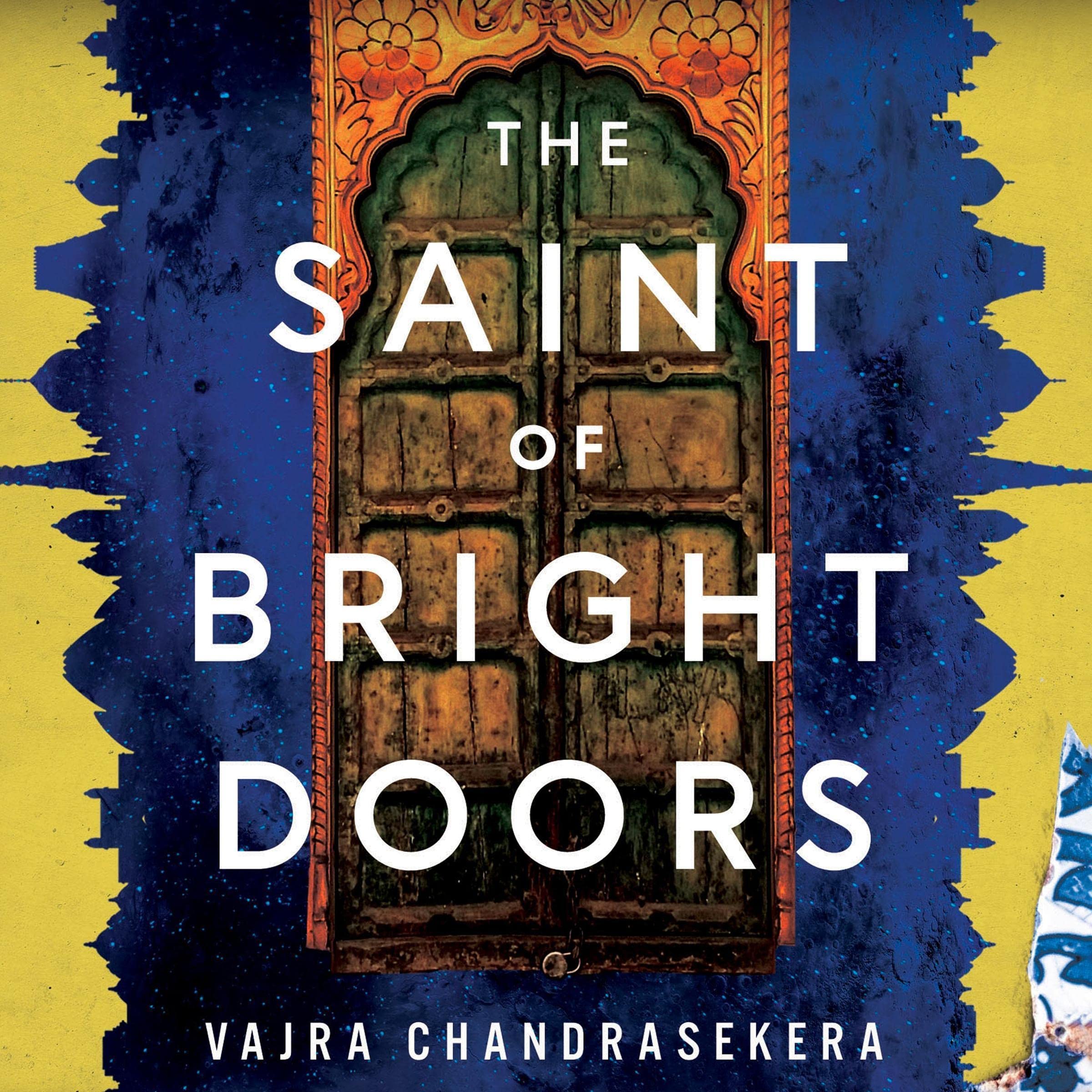
Nestled at the head of a supercontinent, framed by sky and sea, lies Luriat, the city of bright doors. The doors are everywhere in the city, squatting in walls where they don’t belong, painted in vivid warning. They watch over a city of art and avarice, of plagues and pogroms, and silently refuse to open. No one knows what lies beyond them, but everyone has their own theory and their own relationship to the doors. Researchers perform tests and take samples, while supplicants offer fruit and flowers and hold prayer …
Nestled at the head of a supercontinent, framed by sky and sea, lies Luriat, the city of bright doors. The doors are everywhere in the city, squatting in walls where they don’t belong, painted in vivid warning. They watch over a city of art and avarice, of plagues and pogroms, and silently refuse to open. No one knows what lies beyond them, but everyone has their own theory and their own relationship to the doors. Researchers perform tests and take samples, while supplicants offer fruit and flowers and hold prayer circles. Many fear the doors as the source of hauntings from unspeakable realms. To a rare unchosen few, though, the doors are both a calling and a bane. Fetter is one of those few.
When Fetter was born, his mother tore his shadow from him. She raised him as a weapon to kill his sainted father and destroy the religion rising up in his sacred footsteps. Now Fetter is unchosen, lapsed in his devotion to both his parents. He casts no shadow, is untethered by gravity, and sees devils and antigods everywhere he goes. With no path to follow, Fetter would like to be anything but himself. Does his answer wait on the other side of one of Luriat’s bright doors?
What an arresting premise. The opening is great too. And it goes in all sorts of unexpected directions. It drags a bit in places while operating in a context I know very little about: Sri Lankan history and Buddhism, by way of fantasy. I still found much of it engaging and learned of the author’s blog post on “Unbuddhism”that should be read once you’re done with this: vajra.me/2021/10/27/%e0%b6%85%e0%b6%b6%e0%b7%9e%e0%b6%af%e0%b7%8a%e0%b6%b0%e0%b6%9a%e0%b6%b8-unbuddhism/
Weird, inventive, and pointed commentary at the same time
5 étoiles
I tore through this book, and might just re-read it immediately, which is something I never do.
It starts out as a fantasy story that feels exceptionally weird because Chandrasekera's willing to do his world building / exposition very slowly. I kept going through a lot of confusion because the writing itself is just so beautiful. And then gradually as the exposition falls into place it becomes clearer that the book is at least partly a critique of religious fanaticisms and chauvinisms... but each time I felt I really had a handle on the book something in its world would shift - either the protagonist learning a new piece of his own story or a significant detail the the author waited until a dramatic moment to show the reader. Even the ending feels like another instance of that, and it is a relatively unclear ending, though it fits the …
I tore through this book, and might just re-read it immediately, which is something I never do.
It starts out as a fantasy story that feels exceptionally weird because Chandrasekera's willing to do his world building / exposition very slowly. I kept going through a lot of confusion because the writing itself is just so beautiful. And then gradually as the exposition falls into place it becomes clearer that the book is at least partly a critique of religious fanaticisms and chauvinisms... but each time I felt I really had a handle on the book something in its world would shift - either the protagonist learning a new piece of his own story or a significant detail the the author waited until a dramatic moment to show the reader. Even the ending feels like another instance of that, and it is a relatively unclear ending, though it fits the whole mood of the book enough not to be frustrating.
To be clear: I like this kind of storytelling better than spending pages and pages on worldbuilding before anything happens, and all loose ends tied up by the conclusion. It just needs a damn good writer to make it work, and Chandrasekera is one. I also never felt like I was more confused than the protagonist himself, which I think is how the book managed not to fall into feeling like a cheap trick.
After reading it, I read up on the story of Rāhula, and realised that many more details in this book are clearly-intentional references to that than I'd picked up on. And I read some Sri Lankan history and realised that much of what felt like echoes of Myanmar or Israel were more direct references to specific aspects of Sri Lanka's civil war. Part of why I want to re-read is to have those things in mind, but I think it's also a strength of the book that it works as a more general allegory too. I think I would advise other readers to go in the same order as me: dive into the book first, and catch up on its references after.
A very interesting setting and unconventionnal story
4 étoiles
There are a lot of good ideas in this book. The worldbuilding—mixing contemporary elements with timeless themes, the characters, the story arc… I enjoyed reading it :)